Community Inclusion · Franklin Park, NJ
Community Inclusion for Adults with I/DD in Franklin Park, NJ
Folak Adult Social Day Program supports adults 21 and older with intellectual and developmental disabilities to belong to everyday community life — clubs, classes, volunteering, faith, and recreation — alongside their neighbors in Somerset County.
Definition
What is community inclusion in a NJ day program?
Community inclusion is individualized or small-group support that helps adults with I/DD participate in and belong to typical community life — clubs, classes, volunteering, faith, recreation — building friendships in integrated settings, per New Jersey DDD.
What does community inclusion include at Folak?
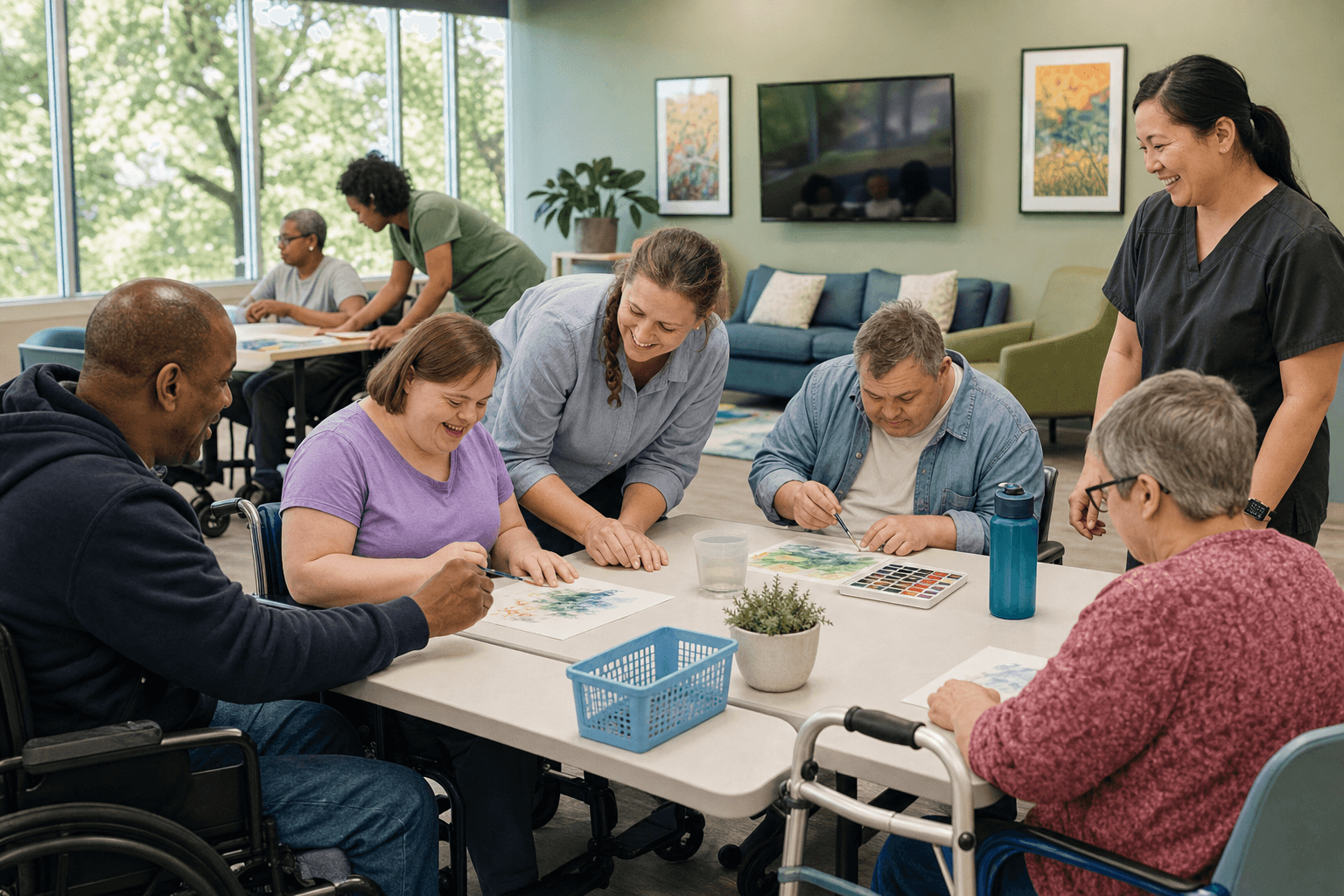
Community inclusion connects participants to clubs, recreation, arts, faith communities, civic groups, volunteering, and classes in real community settings — not facility programming — one-to-one or in small interest-based groups built around each person's chosen interests.
Membership over outings. New Jersey DDD frames Community Inclusion Services as support to actively participate in and belong to typical community life, distinct from errands or facility-based activities. At Folak, that translates into ongoing involvement — a recurring art class, a library volunteer shift, a congregation, a fitness group — where participants become familiar faces rather than occasional visitors.
Interest-driven and integrated. The Arc describes inclusion as people with I/DD taking part in the same community spaces as everyone else. Folak staff support participation in mainstream settings across Franklin Park and Somerset County, then fade their presence as natural relationships with classmates, fellow volunteers, and neighbors grow.
Who does community inclusion help?
Community inclusion serves adults 21 and older with intellectual and developmental disabilities who want broader social lives and stronger community ties, enrolled in New Jersey DDD's Supports Program or Community Care Program.
Eligibility follows DDD's adult criteria. New Jersey DDD serves adults whose developmental disability appeared before age 22, involves substantial limitations in major life activities, and qualifies for NJ FamilyCare Medicaid, per N.J.S.A. 30:6D-3. Folak welcomes participants across this range, including people with autism, cerebral palsy, intellectual disability, epilepsy, and related conditions.
A fit for people seeking belonging. AAIDD frames intellectual disability through support needs rather than limits, and community inclusion suits participants whose goals center on friendship, contribution, and presence in the wider community. Folak's Adult Social Day Program pairs this focus with its capacity-80 day program in Franklin Park.
How does community inclusion work day to day?
Community inclusion starts with each person's interests, then builds a routine of regular community participation supported by Folak direct support staff in libraries, gyms, houses of worship, volunteer sites, and classes — one-to-one or in small interest groups.
Goal-based, not drop-in. New Jersey DDD documents Community Inclusion against the participant's ISP outcomes on activity logs. Folak tracks progress toward each person's chosen goals — joining a group, sustaining a volunteer role, widening a circle of friends — and adjusts support as confidence grows.
Staff who step back as belonging grows. The CMS HCBS Settings Rule (42 CFR 441.301) calls for integrated, non-isolating settings with full community access. Folak staff provide as much hands-on help as a person's NJ CAT support tier reflects, then gradually fade so natural supports — peers, mentors, and neighbors — take the lead.
How does community inclusion fit the ISP and funding?
Community inclusion is a Medicaid-funded New Jersey DDD service authorized through each participant's Individualized Service Plan. The NJ CAT assessment sets a support tier and annual budget, and the ISP lists community inclusion as a funded outcome.
The ISP authorizes everything. New Jersey DDD funds no service without an ISP line item that fits the person's budget and supports a 12-month plan. A Support Coordinator from the family's chosen, independent agency writes the ISP; Folak delivers community inclusion as a provider, then documents outcomes back to the Support Coordinator.
Two waiver pathways. New Jersey DDD offers adult services through the Supports Program and the Community Care Program, both federal 1915(c) home- and community-based waivers within NJ FamilyCare. Tier-based rates reflect each person's assessed need, so higher support needs correspond to more staff time at Folak, all within the authorized DDD budget.
What do families and Support Coordinators expect from Folak?
Families and Support Coordinators expect person-centered planning, real community integration, and transparent communication. Folak builds individualized inclusion goals with each participant, coordinates with the independent Support Coordinator, and reports progress against ISP outcomes — all under New Jersey DDD provider standards.
Choice and dignity built in. The CMS HCBS Settings Rule guarantees participants choice, autonomy, and freedom from isolation. At Folak, participants choose their interests and activities, decline options that do not fit, and pursue relationships in the same settings their neighbors use across Franklin Park and Somerset County.
A provider, not the planner. New Jersey DDD keeps Support Coordination independent of service providers to protect families' interests. Folak partners with each participant's Support Coordinator — sharing activity logs, ISP worksheet input, and outcome updates — so the team sees measurable progress. Families reach Folak directly at (732) 860-9104 or folakhealthcarellc@gmail.com.
What do families ask about community inclusion?
Who is eligible for community inclusion through Folak?
Adults 21 and older with intellectual and developmental disabilities who hold New Jersey DDD eligibility and NJ FamilyCare Medicaid qualify. Per New Jersey DDD and N.J.S.A. 30:6D-3, the disability appeared before age 22 and substantially limits major life activities.
How is community inclusion paid for?
Medicaid through New Jersey DDD funds community inclusion. The NJ CAT assessment sets a support tier and annual budget, the Individualized Service Plan authorizes the service, and Folak bills New Jersey DDD directly for the support the plan authorizes.
How does a family get started with community inclusion?
Start with the Support Coordinator. Families ask their New Jersey DDD Support Coordinator to add community inclusion to the ISP and to refer Folak as the provider. Families also contact Folak directly at (732) 860-9104 to tour the Franklin Park program.
What makes community inclusion effective?
Genuine belonging, not just attendance. The Arc and AAIDD tie outcomes to real relationships and valued community roles. Folak builds recurring participation around each person's interests, fades staff support as natural relationships form, and documents progress toward ISP goals.
How is community inclusion different from day habilitation?
Community inclusion centers on belonging in the wider community, while day habilitation builds broad daily-living and adaptive skills, often partly on-site. Per New Jersey DDD, community inclusion happens in integrated settings and aims at membership, friendships, and natural supports rather than facility programming.
What is the Support Coordinator's role with Folak?
The Support Coordinator plans and monitors; Folak delivers. New Jersey DDD keeps Support Coordination independent of providers. The Coordinator writes the ISP, refers providers, and conducts monthly health-and-safety monitoring, while Folak provides community inclusion and reports outcomes back to the Coordinator.
What other services does Folak offer?
Day Habilitation
Structured daytime programming that builds daily-living, social, and self-care skills — promoting independence, routine, and meaningful engagement for adults with I/DD.
Individual Support
One-to-one assistance matched to each person's goals — support with daily routines, communication, and personal care, delivered with dignity and choice.
Behavior Management
Positive behavioral support that helps individuals self-regulate, communicate needs, and reduce barriers to participation, guided by each person's plan.
Prevocational Training
Work-readiness skill-building — task sequencing, soft skills, and work habits — that prepares individuals for volunteer roles and future employment.
Community-Based Support
Staff-supported access to the wider community — errands, recreation, volunteering, and local activities — that builds real-world skills and natural connections.
Respite
Short-term, reliable relief care that gives family caregivers a break while their loved one stays safely supported and engaged.
Transportation
Reliable rides to and from the day program, community outings, and activities — so getting there is never a barrier. Vans are wheelchair-accessible.
How do you start adult day services in Franklin Park, NJ?
Start with a visit. Schedule a tour or call us, and our team walks you through the center, answers your questions, and sets up a simple intake assessment.