
Our Services · Franklin Park, NJ
Folak Adult Social Day Program Services in Franklin Park, NJ
Eight person-centered supports for adults 21 and older with intellectual and developmental disabilities — from day habilitation and community inclusion to respite, prevocational training, and transportation.
Definition
What services does the Folak Adult Social Day Program provide?
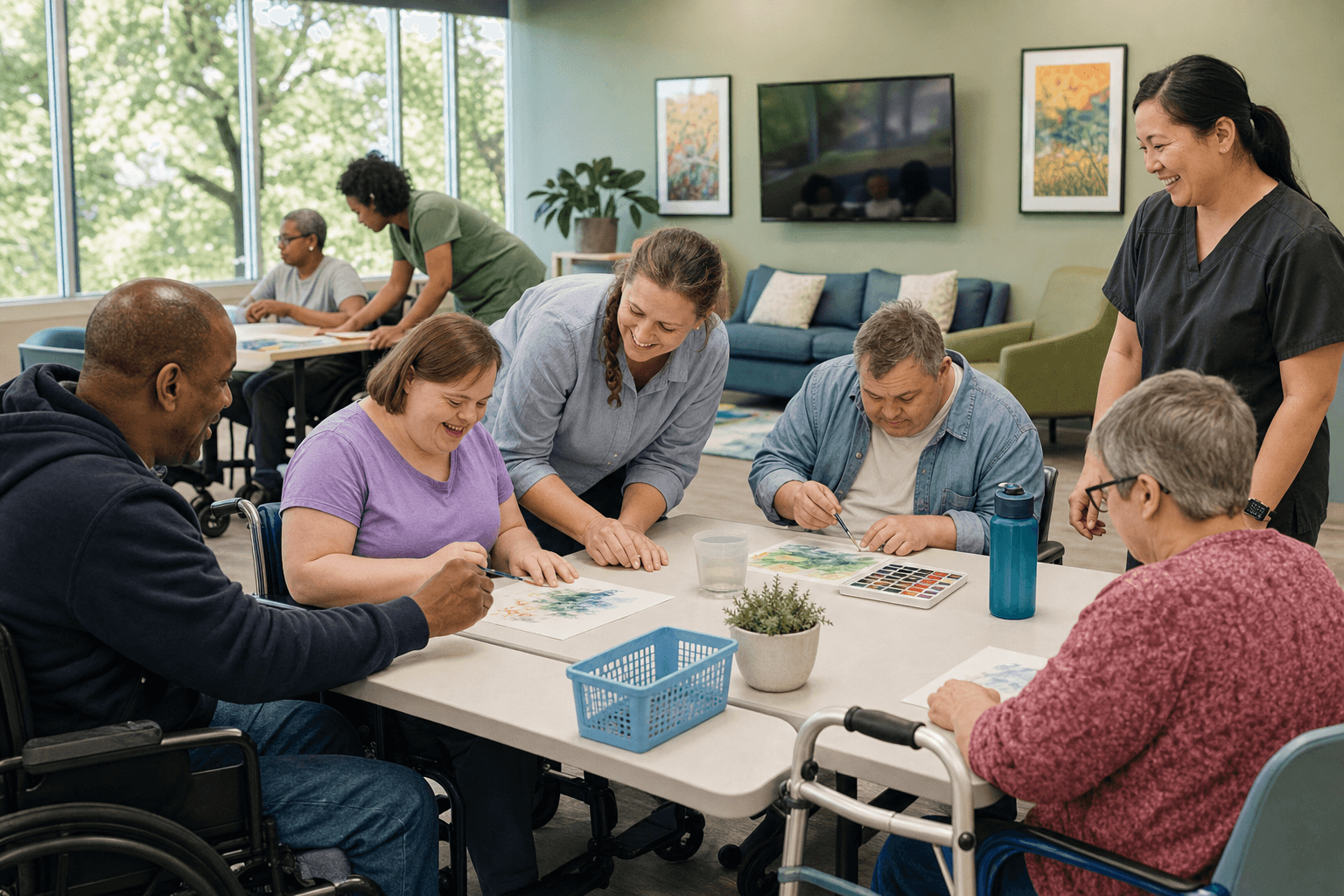
The Folak Adult Social Day Program provides eight person-centered day services in Franklin Park, NJ — day habilitation, community-based support, individual support, respite, behavior management, community inclusion, prevocational training, and transportation for adults 21 and older with intellectual and developmental disabilities.
What does daily support & skill-building include at the program?
Day Habilitation
Structured daytime programming that builds daily-living, social, and self-care skills — promoting independence, routine, and meaningful engagement for adults with I/DD.
Individual Support
One-to-one assistance matched to each person's goals — support with daily routines, communication, and personal care, delivered with dignity and choice.
Behavior Management
Positive behavioral support that helps individuals self-regulate, communicate needs, and reduce barriers to participation, guided by each person's plan.
Prevocational Training
Work-readiness skill-building — task sequencing, soft skills, and work habits — that prepares individuals for volunteer roles and future employment.
What does community & family include at the program?
Community-Based Support
Staff-supported access to the wider community — errands, recreation, volunteering, and local activities — that builds real-world skills and natural connections.
Community Inclusion
Opportunities to take part in community life — outings, social groups, and civic activities — that build belonging beyond the program walls.
Respite
Short-term, reliable relief care that gives family caregivers a break while their loved one stays safely supported and engaged.
Transportation
Reliable rides to and from the day program, community outings, and activities — so getting there is never a barrier. Vans are wheelchair-accessible.
What is day habilitation for adults with developmental disabilities?
Day habilitation is structured daytime support that builds life, social, and self-care skills for adults with intellectual and developmental disabilities, helping each person grow more independent and take part in the community.
Day habilitation anchors the Adult Social Day Program in Franklin Park. The New Jersey Division of Developmental Disabilities describes day habilitation as services that help adults acquire, retain, and improve self-help, socialization, and adaptive skills in a structured day setting.
Skill-building happens through everyday routines — communication practice, daily-living tasks, group projects, and community outings — each matched to the goals in an adult's Individualized Service Plan.
How do community-based support and community inclusion work together?
Community-based support is staff-guided help to get out into community settings, and community inclusion is full participation in community life — outings, social groups, and civic activities that build belonging beyond the program walls.
Community-based support pairs each adult with staff for errands, recreation, volunteering, and local activities that turn everyday outings into real-world practice and natural connections.
Community inclusion reflects a core value of The Arc: people with intellectual and developmental disabilities belong in the community, with the relationships and roles that belonging brings.
How does behavior management support participation?
Behavior management uses positive behavioral support to help adults self-regulate, communicate needs, and lower barriers to participation — strategies written into and guided by each person's plan.
Positive behavioral support focuses on understanding the reason behind a behavior and teaching skills that meet the same need a different way, an approach grounded in the person-centered values of AAIDD.
Individual support complements this with one-to-one assistance — help with routines, communication, and personal care — delivered with dignity and choice for adults with I/DD in Franklin Park.
What does prevocational training prepare adults for?
Prevocational training builds the general work-readiness skills — task sequencing, staying on task, teamwork, and workplace habits — that prepare adults with I/DD for volunteering or supported employment.
Prevocational training centers on transferable habits rather than a single job, so each adult gains confidence and skills that carry into many settings.
Respite rounds out the program for families: short-term, reliable relief care that keeps an adult safely supported and engaged while a caregiver rests, works, or attends to other needs.
Who qualifies for day services in NJ?
day services in New Jersey serve adults age 21 and older with intellectual and developmental disabilities who meet the New Jersey Division of Developmental Disabilities definition and hold NJ FamilyCare Medicaid.
Eligibility rests on three tests, per New Jersey DDD. First, the person reaches age 21, the point where services move from the Children's System of Care to the Division of Developmental Disabilities (DDD). Second, the person meets the developmental disability definition in N.J.S.A. 30:6D-3, a severe, chronic condition manifested before age 22, with substantial functional limitations in three or more major life activities. Third, the person holds NJ FamilyCare Medicaid, since these day programs run as Medicaid home and community-based services.
Medicaid structures how these day programs operate. Since July 2015, New Jersey DDD funds services as fee-for-service, prior-authorized in each person's ISP and billable only by DDD-approved providers. This eligibility framework gives individuals and families a consistent path into adult day programs across the state.
How do the Supports Program and Community Care Program fund day programs?
Two DDD programs fund day programs in New Jersey: the Supports Program for adults living at home or with family, and the Community Care Program for adults at an institutional level of care. Both operate as Medicaid waivers.
The Supports Program serves individuals who live at home, with family, or in non-licensed settings, and it funds community supports without DDD-funded residential placement. Most participants in community day programs attend through this program, with independent support coordination arranging their services.
The Community Care Program serves individuals assessed at an institutional (ICF/IID) level of care and often includes DDD-funded residential settings such as group homes. Per New Jersey DDD, Day Habilitation is available on either program, up to 30 hours per week excluding transportation, so participants in both programs access the same core day services.
What does a Support Coordinator do for day program participants?
A Support Coordinator from an independent, conflict-free agency develops the person-centered plan and ISP, locates providers, and performs monthly health-and-safety monitoring. Individuals choose their agency and change it freely.
Independent Support Coordination keeps planning separate from service delivery, per New Jersey DDD. The Support Coordinator drives the Individualized Service Plan, NJ CAT reassessments, and provider referrals. The Boggs Center publication on selecting a Support Coordination Agency gives families a practical tool for this choice. The program itself, as a Day Habilitation provider, is not the coordination agency.
The ISP combines a narrative, a budget, and the authorization that makes each service billable, scored on nine components including Person-Centeredness. As a Day Habilitation provider, the program completes an ISP Worksheet with each participant at least 30 days before the annual meeting and shares it with the Support Coordinator, guardian, and team.
How does respite care support families alongside a day program?
Respite provides short-term, temporary care that relieves unpaid family caregivers while keeping the person safe and engaged. Its purpose centers on caregiver relief rather than skill-building, per New Jersey DDD.
Respite runs in the person's home, a qualified caregiver's home, a licensed group home, or the community, billed hourly or overnight within annual limits. Per New Jersey DDD, respite generally does not apply to individuals already in 24-hour paid residential settings.
Alongside day programs, respite gives families breathing room during evenings, weekends, or emergencies, while Day Habilitation and Community-Based Supports handle weekday habilitation. This distinction matters: respite offers relief, while the other services pursue life skills development and community participation.
What is the difference between individual support and community-based support?
Individual Supports covers self-care and habilitation tasks staff perform or supervise in the person's own or family home, while Community-Based Supports delivers similar assistance out in community locations.
Individual Supports, per New Jersey DDD, includes activities of daily living and household tasks such as cooking, cleaning, laundry, and hygiene, taught to build independent daily living and billed in 15-minute or daily-rate units. The home is the locus of this service.
Community-Based Supports moves into stores, banks, transit, classes, and volunteer sites, building independence through everyday tasks like errands, money management, and travel training, billed in 15-minute units. Together these services offer individuals flexible support and everyday opportunities that follow their interests and routines across home and community.
How does the NJ CAT tier shape a day program budget?
The NJ CAT assessment measures self-care, behavioral, and medical need, assigns a tier, and sets an annual budget plus tier-based rates for Day Habilitation and Community Inclusion, per New Jersey DDD.
Tiers translate need into funding. A higher assessed need produces a higher rate, which supports more staffing for that person. Reassessment opens when needs change, so the budget tracks the individual over time rather than staying fixed.
The ISP authorizes every service within that budget for a 12-month span, and no service bills without an ISP line. This funding mechanic shapes how adult day programs staff their rooms and design programming, matching support intensity to each participant's profile and interests.
How does the HCBS Settings Rule shape day program experiences?
The HCBS Settings Rule (42 CFR 441.301) requires integrated settings, full community access, choice, and non-isolating programming. CMS states that community-based settings include Day Habilitation settings.
Community integration sits at the center of this rule, per CMS. Day programs operate as gateways to typical community life rather than closed facilities, giving individuals real opportunities to participate in stores, classes, recreation, and volunteering. The daily schedule reflects genuine community integration, not facility-only activity.
Choice and rights anchor the experiences a quality program offers. Participants decline activities, select alternatives, and follow their own interests, while the program documents outcomes against ISP goals. These experiences align with CMS HCBS assurances and the National Core Indicators domains that measure community participation and satisfaction.
Who is eligible, and how do families begin services?
Adults 21 and older with intellectual and developmental disabilities qualify for these day services, generally funded through New Jersey DDD and NJ FamilyCare Medicaid. Families begin by contacting the program and completing intake.
Eligibility follows New Jersey DDD criteria — a developmental disability that began before age 22 and substantially limits major life activities, alongside Medicaid enrollment. The team reviews each person's situation and coordinates with their Support Coordinator to confirm funding.
To begin, families provide basic information, complete an intake visit, and review the Individualized Service Plan. Once the plan and DDD funding are received and confirmed, the program ensures supports are in place before the first day in Franklin Park.
What do families ask about Folak's services?
Who is eligible for Folak's day services?
Adults 21 and older with an intellectual or developmental disability that began before age 22 and substantially limits major life activities qualify, generally through New Jersey DDD. The team reviews each person's situation during intake.
How are day services funded in New Jersey?
New Jersey DDD funds day services through Medicaid Home and Community-Based Services waivers — the Supports Program and the Community Care Program. Folak coordinates with each adult's Support Coordinator on funding.
Does each adult get an individualized plan?
Yes — each adult's services follow an Individualized Service Plan (ISP). Staff match day habilitation, supports, and activities to the goals, strengths, and preferences named in that plan.
How many adults does the program serve?
The Adult Social Day Program serves up to 80 participants. Small-group and one-to-one support keep attention personal, even at full capacity, in Franklin Park, NJ.
How do families learn more about the services?
Families reach Folak at (732) 860-9104 or folakhealthcarellc@gmail.com. The team explains eligibility, DDD funding, and the intake visit for the Franklin Park program.
Does the Adult Social Day Program provide transportation to its day program?
Transportation depends on each person's plan and funding. New Jersey DDD handles transportation separately from Day Habilitation hours. Families confirm the specifics with their Support Coordinator and with the program office at (732) 860-9104.
At what age do adults transition to day services?
Adults transition to DDD at age 21. Birth through 21 falls under the Children's System of Care through PerformCare, and the New Jersey Division of Developmental Disabilities serves eligible individuals from age 21 onward, per New Jersey DDD.
Does the program provide skilled nursing or therapies?
The Adult Social Day Program provides non-medical habilitation, not skilled nursing or therapies. Per New Jersey DDD, Day Habilitation builds life skills and community participation, while medical adult day health under N.J.A.C. 8:43F is a separate, nursing-supervised category.
How many adults does the Franklin Park day program serve?
The Franklin Park program has a capacity of 80 participants. Folak operates the Adult Social Day Program in Franklin Park, Somerset County, for adults 21 and older with intellectual and developmental disabilities.
Do participants combine more than one service in a day?
Participants combine services such as Day Habilitation, Prevocational Training, and Community-Based Supports in one day when the services run separately, never concurrently, and each appears in the ISP and budget, per New Jersey DDD.
How does a family choose a day program provider?
Families choose a day program provider through their independent Support Coordinator, who shares provider information and arranges visits. Individuals select providers listed in the DDD Provider Search and change providers according to their own preferences, per New Jersey DDD.
What information does a family bring to enroll?
Families bring the ISP, NJ CAT tier information, and NJ FamilyCare Medicaid eligibility details to enroll. The Support Coordinator and the program office coordinate the ISP Worksheet at least 30 days before the annual meeting, per New Jersey DDD.
How do you start adult day services in Franklin Park, NJ?
Start with a visit. Schedule a tour or call us, and our team walks you through the center, answers your questions, and sets up a simple intake assessment.